Seismic Isolation Design Under ASCE 7-22 Chapter 17
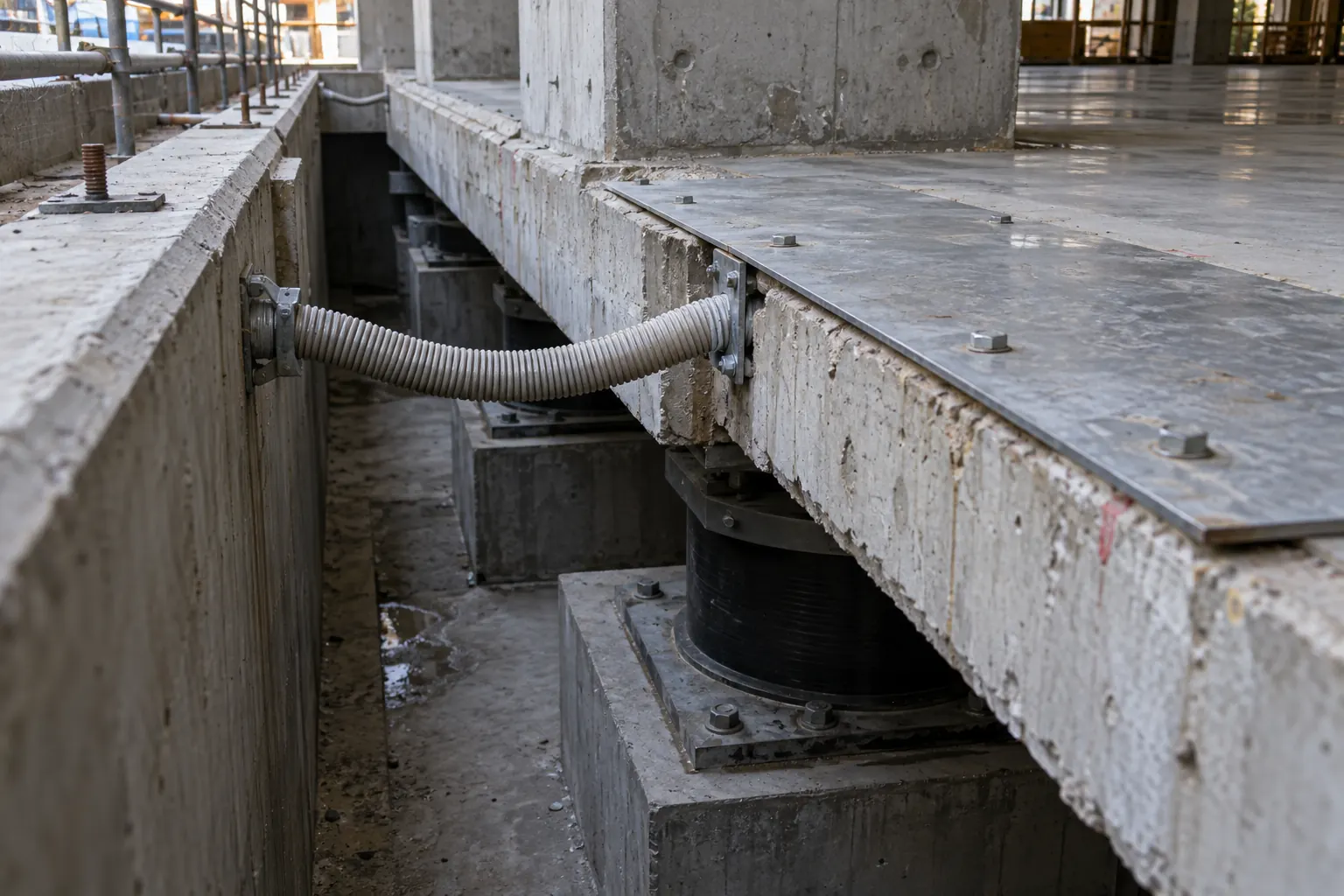
If your project is going to be seismically isolated in the United States, the governing document is Chapter 17 of ASCE 7-22. Everything downstream of that decision, the analysis you are allowed to use, the testing you have to pay for, the peer review you cannot skip, is set there.
This is a walk through what Chapter 17 actually asks for, written for the person paying for the building rather than the person running the model.
What changes when a building is isolated
A conventional building resists earthquakes by yielding. The code accepts damage and sets the acceptance criteria around life safety. An isolated building takes the opposite approach: the isolation system absorbs the displacement, and the superstructure is expected to stay essentially elastic.
That inversion drives the whole chapter. Because the superstructure is meant to survive without damage, the code will not let you take the same liberties with analysis and testing that a conventional design allows. It compensates by demanding more evidence.
One design level: MCE_R
Since ASCE 7-16, Chapter 17 determines every isolation system quantity at a single earthquake level, the risk targeted maximum considered earthquake (MCE_R). Earlier editions worked with a separate design earthquake alongside the MCE; that two level framework is gone for isolated buildings, and material based on it is out of date:
| Quantity | How Chapter 17 sets it |
|---|---|
| Isolation system: maximum displacement, isolator forces and stability, the moat width, every flexible utility crossing | Determined directly at MCE_R |
| Superstructure design forces | Derived from the MCE_R response, reduced by the RI factor |
For general, nonisolated structures the code still defines a design earthquake as two thirds of MCE_R, but an isolated building is no longer designed around that lower level.
The practical consequence: the moat and utility crossings are sized at MCE_R, the same level the whole isolation system is designed for. When someone proposes trimming the moat to recover floor area, this is the provision they are proposing to violate.
Which analysis you are allowed to use
Chapter 17 permits equivalent lateral force, response spectrum and response history analysis, but the limits on the simpler methods are narrow. In practice, most real isolated buildings end up in nonlinear response history analysis, because the qualifying conditions for the simpler procedures involve constraints on site class, structural regularity, period and building height that most projects fail.
What that means commercially: budget for a nonlinear analysis with a suite of scaled ground motions, and budget for the structural engineer's time to run and interpret it. This is not a line item you can value engineer out; it is how the design gets approved.
Upper and lower bound properties
Isolator properties are not a single number. They vary with temperature, aging, rate of loading, contamination, and scragging in the case of elastomeric bearings. Chapter 17 requires the design to be checked at both bounds of the property range, using property modification factors.
This matters to owners because it explains something that otherwise looks like overdesign: the building is analyzed twice, once assuming the softest credible isolation system and once assuming the stiffest. Lower bound generally governs displacement, which drives the moat. Upper bound generally governs the forces delivered into the superstructure. Both have to work.
Prototype and production testing
Chapter 17 sets out a testing regime with two parts:
- Prototype testing, on units representative of the production run, taken through a prescribed sequence of cycles up to the maximum displacement. This establishes the nominal properties and demonstrates stability.
- Production testing, on a sampled fraction of the actual units going into the building, verifying that manufactured properties fall within the range assumed in design.
Two owner facing implications. First, this testing costs real money and takes real schedule time; it belongs in the project program from the start, not in the shop drawing phase. Second, if production tests come back outside the assumed range, the analysis may need revisiting. Building float into the procurement schedule protects you here.
Independent peer review
Chapter 17 requires independent structural design review for isolated structures. The reviewer looks at the site specific seismic criteria, the design of the isolation system, the testing program and the analysis.
Owners consistently underestimate the timing consequence. Bringing the reviewer in after the design is complete converts review into rework. Engaging them at criteria stage, before the ground motions are selected, costs the same in fees and far less in schedule. We cover this in more depth in the peer review requirements article.
The moat, and why it keeps shrinking
The isolation system only works if the building can actually move. Chapter 17 requires clearance around the structure sized for the maximum displacement, and it requires that clearance to remain clear for the life of the building.
In practice the moat is under pressure from every direction: it consumes site area, complicates the entrance sequence, needs cover plates that have to move, and is a maintenance item nobody budgeted for. It also gets consumed after occupancy, by a planter, a ramp, a utility run, or storage.
An isolated building with a compromised moat is a conventional building that paid for isolation. This is worth stating explicitly in the operations manual handed to facilities management.
Utility crossings
Every pipe, conduit, duct and elevator rail that crosses the isolation plane has to accommodate the maximum displacement. That means flexible connections designed for the specific displacement, not generic expansion fittings.
This scope sits at the boundary between structural, mechanical, electrical and vertical transportation, which is exactly why it falls through the cracks. On an isolated project it needs a named owner in the design team.
What an owner should actually track
- Is the peer reviewer engaged before ground motion selection? If not, you are buying rework.
- Is prototype and production testing in the schedule and the budget? With float for a failed production test.
- Has the moat width been fixed, and is it protected in the architectural drawings? Watch for it shrinking between design stages.
- Who owns the utility crossing scope? Name a person, not a discipline.
- Is inspection access to the isolation level designed in? Lighting, clearance, and a route. Retrofitting access later is expensive.
- Does the supply contract require production test records from your batch? Prototype tests from a different run are not the same evidence.
Conclusion
Chapter 17 is demanding by design. It permits a building to be designed for nearly elastic behavior, and in exchange it requires nonlinear analysis, bounded property checks, physical testing and independent review. The provisions that most often cause trouble are not the analytical ones. They are the moat and the utility crossings, because those are where the structural intent meets the rest of the design team.
If you have an isolated project in planning and want the requirements mapped against your current program and budget, book a call.
Frequently Asked Questions
What code governs seismic isolation in the United States?
Chapter 17 of ASCE 7-22, adopted through the International Building Code. It sets the analysis procedures, the single MCE_R design level, the isolator property bounding requirements, the prototype and production testing regime and the independent peer review requirement.
At what earthquake level are isolated buildings designed?
Since ASCE 7-16, everything about the isolation system, the maximum displacement, the isolator forces, the moat width and every flexible utility crossing, is determined at the risk targeted maximum considered earthquake (MCE_R). Superstructure design forces are derived from the MCE_R response, reduced by the RI factor. The older two level framework with a separate design earthquake no longer applies to isolated buildings.
Can equivalent lateral force analysis be used for an isolated building?
Rarely. The qualifying conditions involve limits on site class, structural regularity, period and height that most real projects fail. Nonlinear response history analysis with a suite of scaled ground motions is the practical norm and should be budgeted from the start.
What is isolator property bounding?
Isolator properties vary with temperature, aging, loading rate and contamination. The design must be checked at both the upper and lower bounds of the credible property range using property modification factors. Lower bound generally governs displacement and moat width; upper bound generally governs forces into the superstructure.
What goes wrong most often on isolated projects?
The moat and the utility crossings. The moat gets compressed during design and filled after occupancy; crossings fall between structural, mechanical and electrical scopes and end up rigid. Either one can neutralize the isolation system while the bearings themselves are perfectly sound.
Similar Articles
ASCE 7 Chapter 17 Seismic Isolation Design Requirements: An Owner's Guide
What ASCE 7 Chapter 17 requires of a seismically isolated building: scope, isolation system rules, ELF vs response history...
Read articleCodes & ComplianceASCE 7 Chapter 17 Peer Review Requirements
ASCE 7 Chapter 17 peer review requirements explained: what Section 17.7 requires, the six part review scope, who can review,...
Read articleProcurementSeismic Isolator Specifications and Testing: What to Require in Your RFQ
The document that protects an owner in an isolator purchase is the specification. Prototype vs production testing, EN 15129,...
Read article