How Long Does a Reinforced Concrete Building Last?
Ask how long a concrete building lasts and you will get a number: fifty years, maybe a hundred. Both are wrong in the same way. Concrete does not have an expiration date. It has a deterioration rate, and that rate is set by decisions made before the first pour.
Two buildings framed identically, poured the same week, can be forty years apart in practical service life because one sits in a heated Midwest office park and the other takes salt spray on a Florida barrier island. This article is about what actually governs that difference, and how to tell where your building sits on the curve.
Where the fifty year number comes from
The fifty year figure is real, but it does not mean what people think. Structural codes use a reference period for calibrating load statistics. When a code says a wind or snow load has a given probability of exceedance, that probability is stated over a 50 year window. It is a statistical convention for setting design loads.
It is not a prediction that the building falls down in year 51. A properly detailed and maintained reinforced concrete structure in a benign environment routinely passes a century. Plenty of early twentieth century concrete frames are still in full service in cities on every continent that had cement by then. Equally, a poorly detailed parking deck in a deicing climate can need major structural repair inside 25 years.
So the useful question is not "how many years." It is "what is going to consume this structure, and how fast."
How reinforced concrete actually deteriorates
Concrete itself is chemically stable and gains strength for years after casting. The vulnerable component is the steel inside it.
Fresh concrete is strongly alkaline, around pH 13. At that alkalinity a microscopic passive oxide film forms on the reinforcing steel and stops it corroding. Everything that shortens a concrete building's life comes down to something destroying that film.
Carbonation
Carbon dioxide from the air penetrates the concrete pore structure and reacts with the calcium hydroxide in the cement paste. The reaction products are harmless in themselves, but they drop the pH to around 9. Below roughly pH 11 the passive film breaks down and the steel starts corroding whenever moisture and oxygen are present.
Carbonation advances from the surface inward, and it slows as it goes because the gas has further to diffuse. The depth is roughly proportional to the square root of time. That has a practical consequence: doubling the concrete cover over the steel does not buy you double the time. It buys you roughly four times.
Chloride attack
This is the dominant mechanism in most of the United States where deterioration is severe. Chloride ions from deicing salt or marine spray migrate through the concrete and break down the passive film locally, even where the pH is still high. The result is pitting corrosion: concentrated, deep, and much more damaging per unit of steel loss than the general corrosion carbonation produces.
Chlorides are why parking structures in Chicago and bridge decks in the Northeast deteriorate faster than the office towers next to them, despite identical concrete.
Why corrosion breaks the concrete
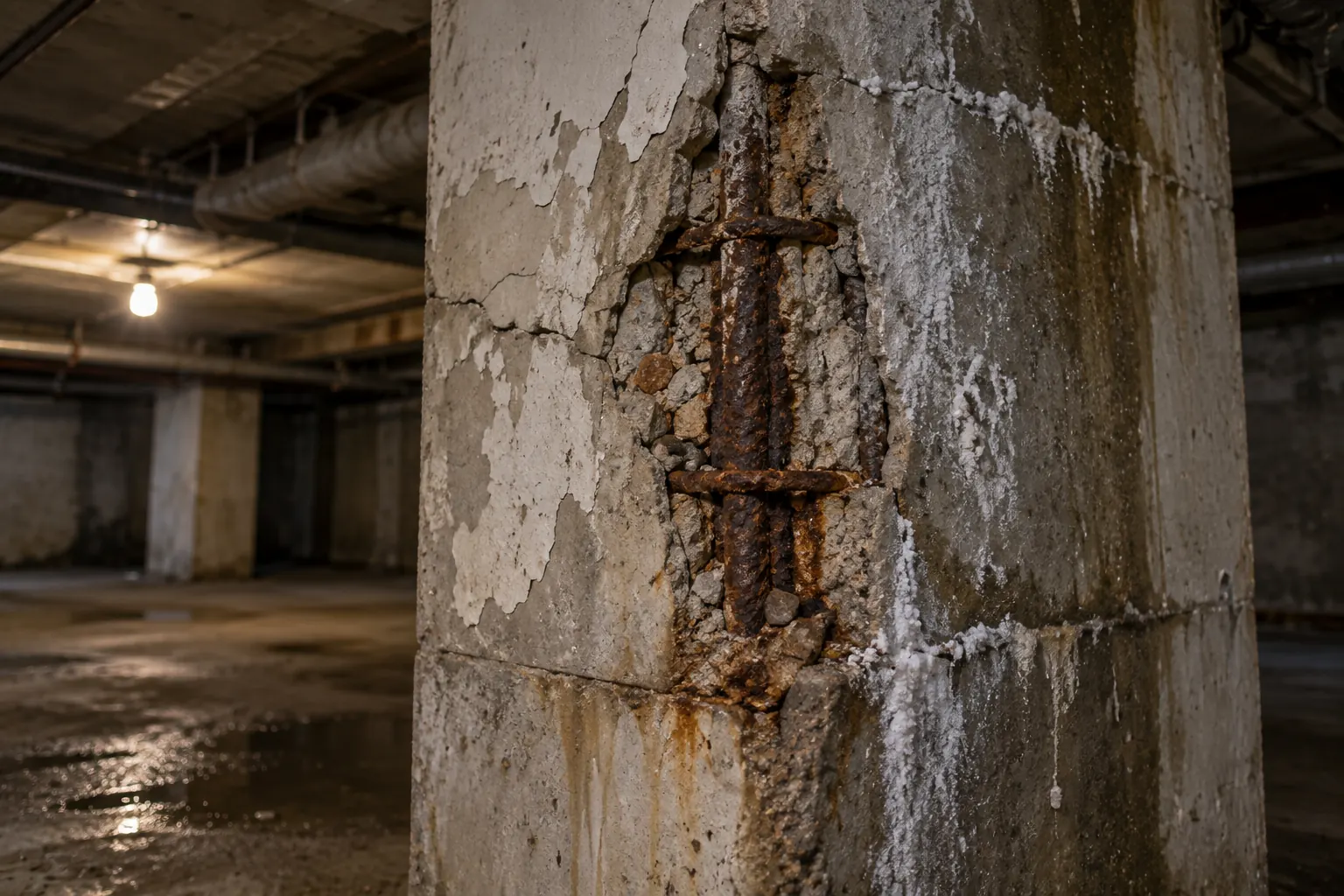
Corrosion products occupy several times the volume of the steel they replace. That expansion generates tensile stress inside the cover, which cracks, then delaminates, then spalls off in sheets. Once the cover is gone the steel is exposed directly and the process accelerates sharply. The visible rust stains and spalls are not the beginning of the problem. They are the point where it became obvious.
Freezing, thawing and sulfate attack
Water in the pore structure expands about nine percent when it freezes. Without properly entrained air to give it somewhere to go, repeated cycles progressively break down the surface. Sulfates in soil or groundwater attack the cement paste chemically. Both are addressed at the mix design stage and both are largely preventable.
The five things that actually set service life
| Factor | Why it matters | Where it is decided |
|---|---|---|
| Concrete cover over steel | The single strongest lever. Square root relationship means added cover pays back disproportionately | Detailing and site placement |
| Water to cement ratio | Governs pore structure and therefore how fast CO2 and chlorides can move through | Mix design |
| Exposure environment | Coastal, deicing, industrial and buried conditions each drive a different mechanism | Site, unchangeable |
| Crack control | Cracks are express lanes past the cover; width and spacing matter more than total quantity | Reinforcement detailing |
| Drainage and water management | No sustained moisture, no corrosion, regardless of everything else | Architecture and maintenance |
Notice that four of the five are set before occupancy, and three of those four are set on the drawings rather than in the field. Service life is designed in, not maintained in.
What the code already does about this
ACI 318, the building code for structural concrete in the United States, handles durability in Chapter 19 through exposure categories. There are four:
- F for freezing and thawing
- S for sulfate exposure
- W for concrete in contact with water
- C for corrosion protection of reinforcement
Each category is divided into severity classes, and each class carries requirements on maximum water to cementitious ratio, minimum compressive strength, air content and admixtures. Assign the exposure class correctly and the code has already handled most of the durability problem for you. Assign it casually and no amount of later maintenance recovers the difference.
For projects where service life needs to be demonstrated rather than assumed, ACI 365.1R covers service life prediction methodology, and ACI 201.2R is the durability guide.
ACI is not the only code in the room, and the codes do not agree on how to express the question. IS 456:2000, the Indian standard for plain and reinforced concrete, works the same way ACI does. It manages durability through exposure conditions rather than through a number of years. There are five, from mild to extreme, and Table 16 fixes the minimum nominal cover for each: 20 mm at mild exposure, 30 mm at moderate, 45 mm at severe, 50 mm at very severe and 75 mm at extreme. Clause 8.1 defines durable concrete as one that "performs satisfactorily in the working environment during its anticipated exposure conditions during service." The phrase design life does not appear anywhere in the standard, and neither does carbonation. If you have read that IS 456 sets a fifty year or hundred year design life, that claim is not in the code.
EN 1990, the Eurocode basis of structural design, is the one that does put years on it. Table 2.1 gives indicative design working lives: 10 years for temporary structures, 15 to 30 years for agricultural and similar buildings, 50 years for buildings and other common structures, and 100 years for monumental buildings, bridges and other civil engineering works. The UK National Annex revises some of those, taking the monumental category to 120 years.
So the fifty year figure has an address. It is a Eurocode convention for common buildings, and it is indicative rather than a guarantee. If your designer worked to IS 456 or ACI 318, no such number was ever assigned to your structure. Durability was set by exposure class, cover and mix instead.
A concrete house is not a small office frame
Everything above assumes a designed structure with an exposure class assigned to it. A house built to local practice carries whatever cover the bar chairs and the workmanship delivered on the day, and nobody wrote the exposure class down. That gap decides more of the life span of a cement house than the concrete grade does.
The square root relationship is what makes it expensive. IS 456 Table 16 asks for 45 mm of cover in severe exposure and 20 mm in mild exposure. Build to the mild figure on a coastal site and you have not lost a little margin, you have lost most of it, because carbonation depth grows with the square root of time. Cutting the cover by half does not halve the time the steel stays protected. It quarters it.
Two parts of a concrete house are worth looking at before any other. The roof slab is the element with nothing above it, so it takes direct sun, the widest thermal cycling and standing water wherever the fall is wrong. And the elements nearest the ground take splash, rising damp and, near the coast, salt. Both are places where the moisture that every mechanism in this article depends on is concentrated rather than incidental. In much of South Asia the same structure is called RCC, for reinforced cement concrete, and the assessment does not change with the name.
Assessing a building you already own
If the building exists, the question shifts from prediction to measurement. A structural condition assessment answers it, and the core tests are inexpensive relative to what they tell you.
- Cover survey. A covermeter maps actual cover depth over the steel across the structure. As built cover is frequently less than the drawings show, and the shortfall is not uniform.
- Carbonation depth. Phenolphthalein sprayed on a freshly broken surface turns pink where the concrete is still alkaline. The colorless zone is carbonated. Comparing that depth against measured cover tells you how much protective margin remains.
- Chloride profile. Powder samples drilled at increasing depths, tested for chloride content. This shows whether chlorides have reached the steel and how fast the front is moving.
- Half cell potential. Maps the probability of active corrosion across a surface, including areas that still look sound.
- Core samples. Compressive strength and, on older buildings, whether the concrete matches what the drawings claim.
- Delamination survey. Chain drag or hammer sounding finds the areas where the cover has already separated but has not yet fallen.
The output is not a number of remaining years. It is a map of where the structure is on the deterioration curve, and that determines whether the correct response is sealing, targeted patch repair, cathodic protection or structural strengthening.
Warning signs worth acting on
- Rust staining on soffits or columns. Corrosion is already underway behind the surface.
- Spalled patches with exposed reinforcement. Advanced. The exposed steel is now corroding at an accelerated rate.
- Cracks running parallel to reinforcement. This pattern is corrosion pressure, not structural overload. Different problem, different fix.
- Hollow sound under chain drag. Delamination, meaning cover has separated but not yet fallen. Also a falling object hazard.
- Efflorescence with persistent damp. Water is moving through the concrete and carrying dissolved material with it.
- Deflection that has changed over time. Distinct from the deflection that appeared in the first years, which is normal creep.
Age, condition, and seismic capacity are three separate questions
Owners frequently collapse these into one. They are independent, and conflating them produces bad decisions.
A 1965 concrete frame in excellent material condition can still be seismically inadequate, because the detailing rules that produce ductile behavior did not exist yet. Older frames commonly lack confinement reinforcement at column ends, have insufficient beam column joint detailing, and use column to beam strength ratios that produce a soft story instead of a distributed mechanism. None of that shows up in a chloride profile.
Conversely, a 2005 building with a chloride contaminated parking level can meet modern seismic detailing and still need major repair.
The practical rule: durability assessment tells you whether the material is intact. Seismic evaluation, under ASCE 41, tells you whether the structure behaves acceptably in an earthquake. If your building predates modern seismic detailing and sits in a high seismic region, you need both, and the seismic answer usually drives the larger decision.
Extending service life
Ranked by cost effectiveness, from cheapest to most involved:
- Fix the water. Drainage, flashing, joint sealant, positive slope. Nothing else on this list matters if water keeps arriving.
- Surface treatments. Silane and siloxane penetrating sealers reduce chloride ingress substantially on exposed decks. Reapplication is periodic and cheap.
- Patch repair, done correctly. Remove concrete behind the bar, not just to it, clean the steel, use a repair mortar compatible with the substrate. Badly done patch repair creates a new corrosion cell at the patch edge and accelerates the problem.
- Cathodic protection. Impressed current or sacrificial anodes stop corrosion electrochemically rather than removing contaminated concrete. Appropriate where chloride contamination is widespread.
- Structural strengthening. Section enlargement, fiber reinforced polymer wrapping, added shear walls or supplemental framing where capacity, not durability, is the issue.
Conclusion
A reinforced concrete building does not expire. It corrodes from the inside at a rate set by cover, mix design, exposure and how well water is kept out. Get those right and a century is unremarkable. Get them wrong and thirty years is optimistic.
If you are weighing repair against replacement, or trying to work out whether an older concrete structure justifies further investment, book a call and we will go through what the condition data is telling you and where the seismic question fits.
Frequently Asked Questions
How long does a reinforced concrete building last?
There is no fixed lifespan. Well detailed concrete in a mild, dry environment commonly exceeds 100 years, while structures exposed to deicing salt or marine spray can require major structural repair within 25 to 30 years. Service life is governed by concrete cover over the reinforcement, water to cementitious ratio, exposure environment and water management, not by age alone.
Where does the 50 year design life figure come from?
Two separate places, and neither is a prediction of failure. Codes state load exceedance probabilities over a 50 year window, which is a calibration convention for setting design loads. Separately, EN 1990 Table 2.1 lists 50 years as the indicative design working life for buildings and other common structures, against 100 years for monumental buildings and bridges. Neither says anything about when a building stops being usable.
What life span does the IS code assign to a building?
None. IS 456:2000 never uses the phrase design life. Clause 8.1 defines durable concrete as one that performs satisfactorily in the working environment during its anticipated exposure conditions during service, and the code then manages that through five exposure conditions and the minimum cover in Table 16, from 20 mm at mild exposure to 75 mm at extreme. Sources that quote a 50 or 100 year design life from IS 456 are quoting something the standard does not contain.
How long does a concrete house last?
The same mechanisms apply, but the cover over the steel is usually the deciding variable rather than the concrete grade, because a house built to local practice rather than to an assigned exposure class gets whatever cover the workmanship delivered. Since carbonation depth grows with the square root of time, cover that is half of what the exposure required costs roughly three quarters of the protected life, not half. The roof slab and the elements nearest the ground are where to look first.
What actually causes concrete buildings to deteriorate?
Corrosion of the reinforcing steel. Fresh concrete is alkaline enough to keep a passive film on the steel. Carbonation lowers the pH and destroys that film; chloride ions from salt break it down locally even at high pH. The corrosion products expand, crack the cover and spall it off, which accelerates everything.
Can an old concrete building be safe in an earthquake?
Material condition and seismic capacity are separate questions. A structure in excellent material condition can still lack the ductile detailing modern codes require, particularly confinement at column ends and adequate beam column joints. Seismic evaluation under ASCE 41 answers that question; a durability assessment does not.
How do I find out what condition my building is actually in?
A structural condition assessment: cover survey, carbonation depth, chloride profile, half cell potential mapping, core samples and a delamination survey. The result maps where the structure sits on the deterioration curve and determines whether sealing, patch repair, cathodic protection or strengthening is the right response.
Similar Articles
Building Strengthening Methods Compared: Which One Fits Your Structure
Jacketing, shear walls, steel bracing, FRP, and base isolation compared on cost, downtime, and the structures each one...
Read articleResidential DesignHow to Build an Earthquake Resistant House
What actually makes a house survive an earthquake: site, plan regularity, a fastened load path and secured contents. Plus the...
Read articleMaintenanceHow Long Do Seismic Isolators Last? What Owners Should Expect
Seismic isolator service life, why standards do not state a number of years, what inspection actually involves, and the six...
Read article